science

The Science Behind Umami and Flavor Pairing

The Biology of Umami

Your taste buds are responsible for detecting the five basic tastes, including umami, which is often referred to as the fifth taste. Umami is associated with savory, meaty, and brothy flavors, and it plays a significant role in the way you experience food.

The Discovery of Umami

Around the turn of the 20th century, a Japanese chef and chemist discovered a new taste that he couldn’t classify as sweet, sour, bitter, or salty, and he named it umami, which roughly translates to “pleasant savory taste” in Japanese.

Umami Receptors and Perception

Towards understanding how you perceive umami, it’s interesting to note that your tongue has specialized receptors that can detect glutamates, which are the amino acids responsible for umami taste, and these receptors send signals to your brain, allowing you to experience the rich, savory flavor of umami.

Umami receptors are found on your taste buds, and when glutamates bind to these receptors, they trigger a response that allows you to perceive the umami taste, and as you explore different foods and flavor combinations, you’ll find that umami is a key component of many rich and satisfying flavors, from the depths of a hearty broth to the intensity of a perfectly aged cheese, and by understanding how umami works, you can enhance your appreciation of these flavors and develop your own unique approach to cooking and eating.
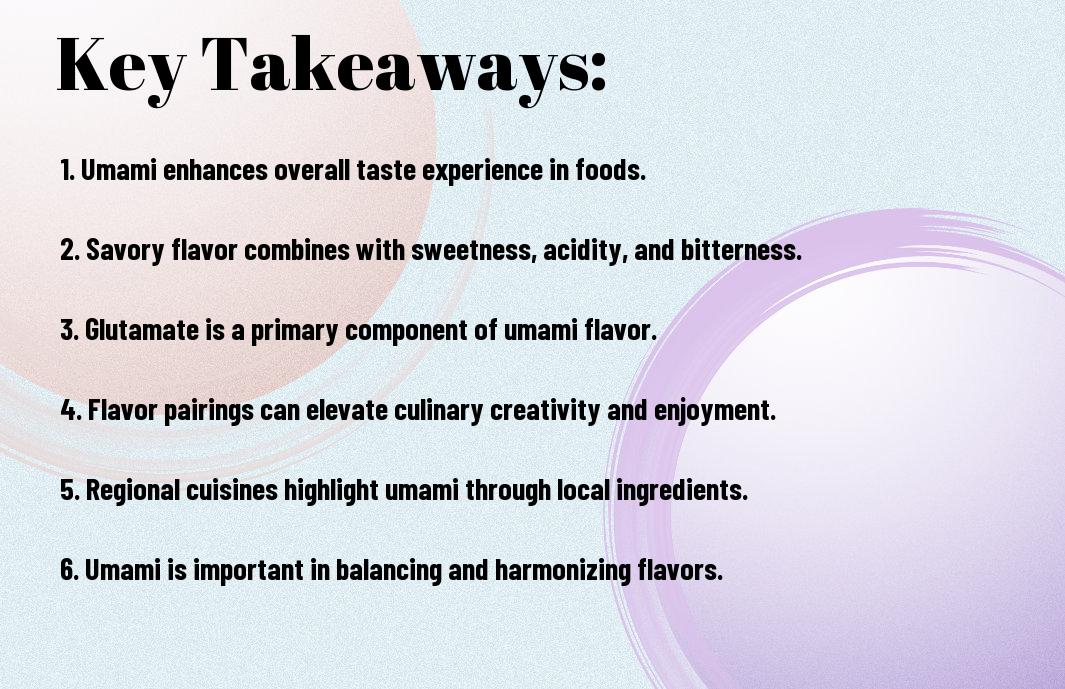
Flavor Profiles and Umami

Some of the most complex and engaging flavors you’ll encounter are those that combine multiple elements, including umami. As you explore the science behind umami, you’ll discover how it enhances and balances your favorite dishes.

Umami-Rich Foods

Beneath the surface of many savory foods lies a depth of umami flavor. You’ll find it in meats, seafood, vegetables, and even some fruits, waiting to be coaxed out by your culinary skills.

Balancing Umami in Recipes

Following the principles of umami, you can create dishes that are both nuanced and satisfying. You’ll learn to balance umami with other flavors, resulting in recipes that are truly greater than the sum of their parts.

Recipes that successfully balance umami often rely on a combination of ingredients, each contributing its own unique character. As you experiment with umami-rich foods, you’ll develop a sense of how to harmonize these flavors, creating dishes that resonate with your taste buds and leave you wanting more. You’ll find that balancing umami is an art that requires a deep understanding of how different ingredients interact, and how you can use them to craft recipes that are both delicious and visually appealing.

The Chemistry of Umami

All the flavors you experience, including umami, are a result of chemical reactions on your taste buds. As you explore the science behind umami, you’ll discover the complex interactions that create this distinct taste sensation.

Glutamates and Nucleotides

Beneath the surface of umami flavor lie glutamates and nucleotides, the compounds responsible for its rich, savory taste. You’ll find these naturally occurring substances in many foods, from meats to vegetables, and they’re also used as flavor enhancers in various products.

Umami Enhancement and Synergy

Likewise, glutamates play a significant role in umami enhancement and synergy, as they amplify the overall flavor experience. You can notice this effect when combining ingredients like mushrooms, soy sauce, and fish, which creates a harmonious balance of tastes.

Another aspect of umami enhancement and synergy is the way it affects your perception of other flavors. As you combine umami-rich ingredients with sweet, sour, or bitter flavors, you’ll notice how they interact and influence each other, creating a more complex and engaging taste experience. You can experiment with different combinations to discover how umami enhances the overall flavor profile of your dishes.

Cultural Significance of Umami

Now that you’ve discovered the science behind umami, let’s explore its cultural significance. Umami is a fundamental element in many cuisines, elevating dishes and creating depth of flavor.

Umami in Traditional Cuisines

Any exploration of umami must consider traditional cuisines, where you’ll find it used to enhance flavors in dishes like Japanese dashi or Italian parmesan cheese, adding richness to your culinary experience.

Umami in Modern Food Culture

By embracing umami, you can take your cooking to the next level, as modern chefs and home cooks alike are discovering new ways to incorporate this flavor into your recipes, from savory sauces to umami-rich vegetables.

Umami is becoming increasingly popular in modern food culture, as you experiment with new ingredients and flavor combinations, discovering how umami can balance and elevate the flavors in your favorite dishes, and even creating new, innovative flavors that delight your palate and broaden your culinary horizons.

Pairing Umami with Other Flavors

Unlike other flavors, umami can elevate and balance your dishes when combined with other tastes, allowing you to create complex and harmonious flavor profiles that enhance your culinary experience.

Umami and Sweetness

Beneath the surface of many sweet dishes, umami flavors can add depth and interest, as you discover how sweetness can bring out the best in umami, creating a delightful harmony of flavors in your cooking.

Umami and Spiciness

With the combination of umami and spiciness, you can create a truly captivating flavor experience, as the heat from spicy ingredients complements the richness of umami, leaving you wanting more of this dynamic duo in your recipes.

But as you explore the pairing of umami and spiciness, you’ll find that the right balance is key, as too much heat can overpower the subtle nuances of umami, so you’ll need to experiment to find the perfect equilibrium that works for your taste, allowing you to fully appreciate the synergy between these two flavors in your cooking.

Applications of Umami in Cooking

For chefs and home cooks alike, understanding umami is key to creating dishes with depth and richness. You can leverage umami to balance and enhance your recipes, adding complexity to even the simplest of meals.

Umami-Rich Ingredients

Around the world, you’ll find ingredients that naturally contain high levels of umami flavor, which you can use to add depth to your cooking.

Techniques for Enhancing Umami

Beside using umami-rich ingredients, you can also employ various cooking techniques to bring out the umami flavor in your dishes, allowing you to create rich and savory meals with ease.

Cooking methods such as caramelization, braising, and roasting can enhance the umami flavor in your ingredients, as these processes break down proteins and concentrate the naturally occurring glutamates. As you experiment with these techniques, you’ll find that your dishes become more complex and satisfying, with a depth of flavor that will leave your guests wanting more. You can apply these methods to a wide range of ingredients, from meats and vegetables to grains and legumes, to create a variety of delicious and umami-rich meals.

Conclusion

As a reminder, you now have a deeper understanding of the science behind umami and flavor pairing. You can apply this knowledge to elevate your cooking by exploring The Science behind great ingredient pairings to create harmonious and delicious dishes, taking your culinary skills to the next level, and enhancing your overall dining experience, as you experiment with your new knowledge of flavor combinations and umami’s role in your cooking.

The Science Behind Baking Perfect Cakes

As you step into the world of baking, you’ll discover that creating the perfect cake is not just about following a recipe, but understanding the chemistry behind it. Your goal is to produce a moist, fluffy, and deliciously flavored cake, and to achieve this, you need to grasp the fundamental principles of baking. You’ll learn how ingredients interact, and how temperature, texture, and timing come together to create your perfect cake.

The Chemistry of Cake Making

While baking a cake, you are vitally conducting a complex chemical reaction, combining ingredients to produce a delicious and visually appealing treat. Your understanding of the chemical processes involved will help you to create the perfect cake, with the right texture, flavor, and appearance.

The Role of Leavening Agents

Besides the basic ingredients, leavening agents play a significant role in cake making, as you will discover when you start experimenting with different types of cakes. You will find that leavening agents, such as baking powder and baking soda, help your cake to rise, giving it a light and fluffy texture.

The Importance of Emulsification

Likewise, emulsification is a key process in cake making, as you will see when you start combining ingredients. You will notice that emulsification helps to mix oil and water-based ingredients together, creating a smooth and stable batter, which is vital for a perfect cake.

The importance of emulsification cannot be overstated, as you will appreciate when you start baking your own cakes. You will find that emulsification helps to distribute the ingredients evenly, ensuring that your cake is consistent in texture and flavor, and that it has a tender and moist crumb, which is exactly what you want to achieve when baking a cake.

The Physics of Cake Structure

There’s a delicate balance of ingredients and reactions that occur during baking, which ultimately determines the structure of your cake. You will find that understanding these principles is imperative to creating a cake that is both delicious and visually appealing.

The Science of Crumb Formation

With the right combination of flour, sugar, and fat, you can create a tender crumb that is the foundation of a perfect cake. You will notice that the type and amount of each ingredient affects the final texture and structure of your cake.

The Art of Achieving Perfect Texture

Physically, the texture of your cake is determined by the interactions between ingredients and the baking process. You can control the texture by adjusting factors such as temperature, mixing time, and ingredient ratios to achieve the perfect balance.

At the heart of achieving perfect texture is understanding how your ingredients interact with each other and with heat. You can experiment with different techniques, such as folding or creaming, to incorporate air and create a light, fluffy texture that you desire in your cake. As you practice and refine your skills, you will develop a sense of how to adjust your recipe and technique to produce the perfect texture every time.

The Biology of Ingredients

Despite the complexity of baking, understanding the biology of ingredients is key to creating perfect cakes. You will find that different ingredients interact with each other in unique ways, affecting the final product’s texture, flavor, and appearance.

The Magic of Yeast Fermentation

Towards a better understanding of yeast fermentation, you will discover that yeast consumes sugars and produces carbon dioxide, causing dough to rise. This process is vital for creating light and airy cakes, and you can control it by adjusting temperature, sugar content, and yeast quantity.

The Wonder of Egg Functionality

Miraculously, eggs play a vital role in cake baking, providing moisture, richness, and structure. You will learn that eggs help to bind ingredients together, creating a smooth and even texture, and their protein content strengthens the cake’s structure.

Due to the unique properties of eggs, you can use them to enhance your cake’s flavor, texture, and appearance. You will find that eggs can be used to add moisture, tenderness, and richness to your cakes, and their emulsifying properties help to combine ingredients smoothly, creating a uniform texture and consistency.

The Technique of Mixing and Blending

All bakers know that the technique of mixing and blending is imperative to creating a perfect cake. You need to understand how to combine ingredients to achieve the right texture and consistency. Your goal is to create a smooth batter that will yield a delicious and moist cake.

The Importance of Proper Creaming

Blending ingredients together is the first step in creating a perfect cake. You will need to cream together butter and sugar until light and fluffy, then add eggs and other ingredients to create a smooth batter. Your creaming technique will affect the final texture of your cake.

The Art of Gentle Folding

Folding in ingredients is a delicate process that you need to master. You will need to gently fold in whipped cream or beaten eggs to create a light and airy texture. Your folding technique will make or break the texture of your cake.

Further to this, when you are folding in ingredients, you should be gentle to avoid deflating the mixture. You can do this by cutting through the center of the mixture with a spatula and gently lifting the ingredients over each other. This will help you create a smooth and even texture, and your cake will be light and fluffy as a result of your careful technique.

The Art of Temperature and Time

Your baking success depends on mastering temperature and time, as outlined in the following

Key Factors

Oven Temperature Affects texture and structure
Baking Time Impacts moisture and flavor

The Science of Oven Temperature Control

Along with precise measurements, you’ll need to control oven temperature, as shown in the

Temperature Guide

Low Temperature Suitable for delicate cakes
High Temperature Best for dense, moist cakes

The Importance of Timed Cooking

Ttherwise, your cakes may not turn out as expected, so consider the

Cooking Times

Short Time Yields light, fluffy texture
Long Time Produces dense, dry texture

Indeed, you will find that timed cooking is imperative to achieve the perfect cake, as it ensures even cooking and prevents overcooking, allowing you to achieve the desired texture and flavor, and with practice, you will be able to adjust your baking time to suit your specific needs and preferences.

Troubleshooting Common Cake Problems

For any baker, identifying and solving issues is key to perfecting your craft. You will encounter problems, but with practice, you can overcome them.

Identifying and Fixing Common Mistakes

Common issues such as uneven baking and soggy textures can be frustrating, but you can fix them by adjusting your techniques and ingredients, ensuring your cakes turn out perfectly.

Tips for Achieving Consistency

After mastering the basics, you can achieve consistency by following these tips:

  • Using quality ingredients
  • Monitoring oven temperature

Recognizing these factors will help you refine your baking skills, allowing you to produce high-quality cakes consistently.

Another aspect of achieving consistency is paying attention to detail, as you measure ingredients and mix batter, you can ensure your cakes turn out light and fluffy:

  • Investing in a digital scale
  • Calibrating your oven

Recognizing the importance of precision will elevate your baking, enabling you to create perfect cakes every time.

Conclusion

Following this comprehensive guide, you now have a deeper understanding of the science behind baking perfect cakes. As you continue to experiment with your recipes, you can refer to The Science of Baking: A Complete Cake Guide for expert tips. With your newfound knowledge, you will be able to create delicious, moist cakes that impress your family and friends, and take your baking skills to the next level, making your baked goods truly exceptional, showcasing your skill and your attention to detail.

Skip to content